


If you're trying to figure out how long to pump breast milk, the general rule of thumb is about 15 to 20 minutes per session. For most women, that’s the sweet spot for fully emptying the breasts, which is the key signal your body needs to keep making milk.
But let's be real—that’s just a starting point. Your perfect pumping duration really depends on your specific goals, your body, and your baby's needs.
Why Pumping Duration Matters


Getting a handle on the "why" behind pumping times can help you feel so much more confident in your routine. Your body works on a simple supply-and-demand system. Every time milk is removed, whether it's by your baby nursing or by your pump, it sends a clear signal to your brain: "Time to make more!"
Top-rated pumps + accessories
Pumping made simpler
Take $15 off at checkout, applied automatically when you shop through this link.
Shop with READER15 →Free US shipping over $100. Code applies automatically at checkout.
Sticking to the right pumping duration keeps that cycle going strong. It doesn't matter if you're exclusively pumping, trying to build up a freezer stash for returning to work, or just needing to relieve some uncomfortable engorgement—getting the timing right is a cornerstone of your breastfeeding journey.
The Rise of the Breast Pump
It feels like almost every new parent has a breast pump these days, and there's a good reason for it. Pumps have become a game-changer for modern families. Studies have shown that by just four months postpartum, a whopping 85% of breastfeeding mothers are using a pump as part of their feeding routine.
This shift really highlights how essential a pump can be for hitting your feeding goals. And when you remember all the incredible lifelong health benefits of breastmilk, it makes every single pumping session feel that much more worthwhile.
Pumping is so much more than just collecting milk. It's a direct conversation with your body. A consistent, effective pumping schedule is how you protect your supply and make sure your little one has everything they need, even when you can't be there.
Ultimately, how and when you pump should fit into your overall feeding plan. Weaving pumping into your nursing schedule takes a bit of trial and error, so be patient with yourself! If you need more tips on creating a rhythm that works for both you and your baby, check out our guide on https://www.moogcobaby.com/blogs/news/establishing-a-feeding-schedule-for-newborn-babies-a-guide-for-new-parents.
To make things a little easier, here’s a quick-glance table to help you match your pumping time to your goal.
Quick Guide to Pumping Duration by Goal
| Pumping Goal | Recommended Duration Per Session | Key Focus |
|---|---|---|
| Building a Freezer Stash | 15-20 minutes | Pumping after a morning feed when supply is highest. |
| Exclusively Pumping | 20-30 minutes | Pumping every 3-4 hours to mimic baby's feeding patterns. |
| Increasing Milk Supply | 10-15 minutes (power pumping) | Short, frequent sessions to signal higher demand. |
| Relieving Engorgement | 5-10 minutes | Just enough to relieve pressure, not fully empty. |
| Replacing a Missed Feed | 15-20 minutes | Pumping around the time the baby would have nursed. |
This table is a great starting point, but always remember to listen to your body and adjust as you go.
Navigating Pumping in the First Few Weeks

Those first few weeks with a new baby are a beautiful, hazy blur of recovery, cuddles, and figuring things out. If pumping is part of your plan, the name of the game is mimicking your newborn’s natural feeding patterns to get your milk supply established and running strong. Think frequency over duration.
Right at the beginning, you'll be pumping colostrum. This is that incredible, nutrient-packed "liquid gold" that your body makes before your mature milk arrives. Don't be surprised if you only get tiny amounts! Pumping sessions for colostrum are usually short, around 10-15 minutes each.
Once your milk fully comes in, which typically happens around 3-5 days after birth, you'll want to stick with that frequent schedule. Aim to pump every 2-3 hours, day and night. It might feel like a lot, but this constant demand is exactly what tells your body to kick milk production into high gear.
When Early Pumping is Essential
For some moms, the pump isn't just a backup—it's a lifeline right from the very beginning. Certain situations make a dedicated pumping routine crucial for building and protecting your supply until you and your baby can get the hang of direct nursing.
- If your baby is in the NICU: Pumping is the best way to give your baby the benefits of your milk while they're getting the specialized care they need.
- When latching is a struggle: Sometimes babies have a tough time getting a good latch. Pumping ensures your little one stays fed and happy while you both work on your nursing skills.
- To manage medical concerns: Things like tongue-ties or other oral restrictions can make nursing tricky. Pumping can be the perfect bridge to get you through.
In these early days, try combining pumping with a bit of hand expression. It’s a fantastic way to collect every last precious drop of colostrum. When you're getting ready for the big day, looking over a list of what to pack in your hospital bag can be a lifesaver, ensuring you have any feeding supplies you might need from day one.
Making Early Pumping Sessions Work
Your comfort is everything, especially while you're healing from childbirth. If pumping hurts, that’s your body telling you something isn't right. It could be a sign of irritation that could lead to bigger problems down the road. Keeping an eye on your breast health is so important. If you want to learn more about potential issues, our guide on https://www.moogcobaby.com/blogs/news/mastitis-prevention-and-management-a-guide-for-breastfeeding-mothers is a great resource.
Pro Tip: Try not to get hung up on how much milk you're getting in those first few weeks. It's the consistency and frequency that truly build a solid long-term supply. Your goal is to empty your breasts, not fill bottles.
It's also worth remembering that the journey is different for everyone. Research shows that long-term success with pumping often comes down to a mother's personal goals, her support system, and the reasons she started pumping in the first place. You can find more about the influential factors in early pumping in this study.
Establishing and Maintaining Your Milk Supply
Once your mature milk comes in, the game changes. You're moving from kick-starting your supply to keeping it going strong for the long haul. Now, the big question—"how long should I pump?"—is all about being efficient and consistent.
Your new magic number is generally 15-20 minutes per session. This isn't just a random number; it's the sweet spot for making sure you fully empty your breasts.
Think of it this way: completely removing milk is the clearest signal you can send your body. It’s like telling it, "Hey, the demand is still high over here!" This regular "order" encourages your body to keep production levels right where you need them.
Mastering the Letdown for Maximum Milk
One of the biggest secrets to a successful pumping session is working with your letdown reflex, not against it. This is that tingly, pins-and-needles feeling you get right before your milk starts to flow freely.
Most pumps come with a "stimulation" or "massage" mode, which uses a quick, light suction pattern to coax this reflex into action. Once you feel that tell-tale tingle and see the milk start to spray, it’s time to switch over to the slower, stronger "expression" mode.
But here’s a pro tip: don't stop at just one letdown. You can often trigger a second (or even a third!) to get more milk in less time.
How to Encourage a Second Letdown
- When the milk flow from your first letdown slows to a trickle, flip your pump back to the stimulation mode for a minute or two.
- While it’s in that mode, gently massage and compress your breasts.
- Looking at a photo or video of your baby can also work wonders for triggering another letdown.
This simple trick can make a huge difference in how much milk you collect in a single 15-minute session.
Consistency Is Your Best Friend
If you're exclusively pumping, consistency is everything. You'll want to mimic a baby’s natural feeding patterns, which typically means pumping 8 to 12 times in a 24-hour period. I know, that sounds like a lot, but it’s this regularity that truly protects your supply.
If you’re primarily nursing and just pumping to build a freezer stash, you can be more flexible. Adding just one or two pumping sessions into your day—often first thing in the morning when supply is naturally at its peak—is a great strategy.
Your goal isn't just to watch the clock. It's to pump until your breasts feel soft and noticeably "emptier." A great rule of thumb is to keep pumping for an extra 1-2 minutes after the last drops of milk appear. This helps ensure you’re getting that rich, fatty hindmilk and sending that all-important signal to your body to keep up the good work.
For even more tips on boosting your output, check out these strategies to increase milk supply. By combining the right pumping duration with these smart techniques, you can feel confident in your ability to maintain your supply for as long as you and your baby choose.
How to Get More Milk From Every Pumping Session
Knowing how long to pump is a great start, but how you pump is where the magic really happens. A few smart techniques can be the difference between a frustrating session and a bottle brimming with liquid gold. It's all about working with your body, not just pumping for longer stretches.
The absolute number one factor for a good pumping session is your flange fit. I can't stress this enough. If your flange is too big or too small, it won't just be uncomfortable—it can actually hurt your milk supply by not draining your breast properly. Is your nipple rubbing painfully against the sides? Is too much of your areola being pulled into the tunnel? Those are clear signs you need to try a different size.
Master Your Pump's Settings
Your breast pump isn't a simple on/off device; those settings are there to mimic how a baby naturally nurses. Always kick off your session in stimulation mode, which you might see called massage mode. This setting uses a light, fast suction pattern that signals your body to trigger a letdown.
Once you feel that familiar tingly rush and see the milk start to spray, it's time to switch over to expression mode. This is a slower, deeper pull. You'll want to find the highest suction level that still feels comfortable. And remember, more suction doesn't automatically mean more milk. Pain can actually stop your letdown in its tracks, so listen to your body.
Powerful Techniques to Boost Your Output
Beyond getting the basics right, a few specific methods can really ramp up how much milk you collect. Working these into your routine can be a total game-changer, especially on those days when your supply feels a little sluggish.
- Double Pumping: Pumping both breasts at once does more than just save you time. It can actually increase your milk output by triggering a stronger release of prolactin, the key hormone for milk production.
- Hands-On Pumping: This is exactly what it sounds like—using massage and breast compressions while you pump. Gently knead your breasts before and during the session, paying extra attention to any firm spots to help the milk flow freely. It's a fantastic way to make sure you're emptying the breast completely.
- Power Pumping: This is a more intensive strategy meant to mimic a baby's cluster feeding during a growth spurt. By pumping in short, frequent bursts over an hour, you send a powerful message to your body to make more milk.
This simple infographic really nails the supply-and-demand principle that drives your milk production.
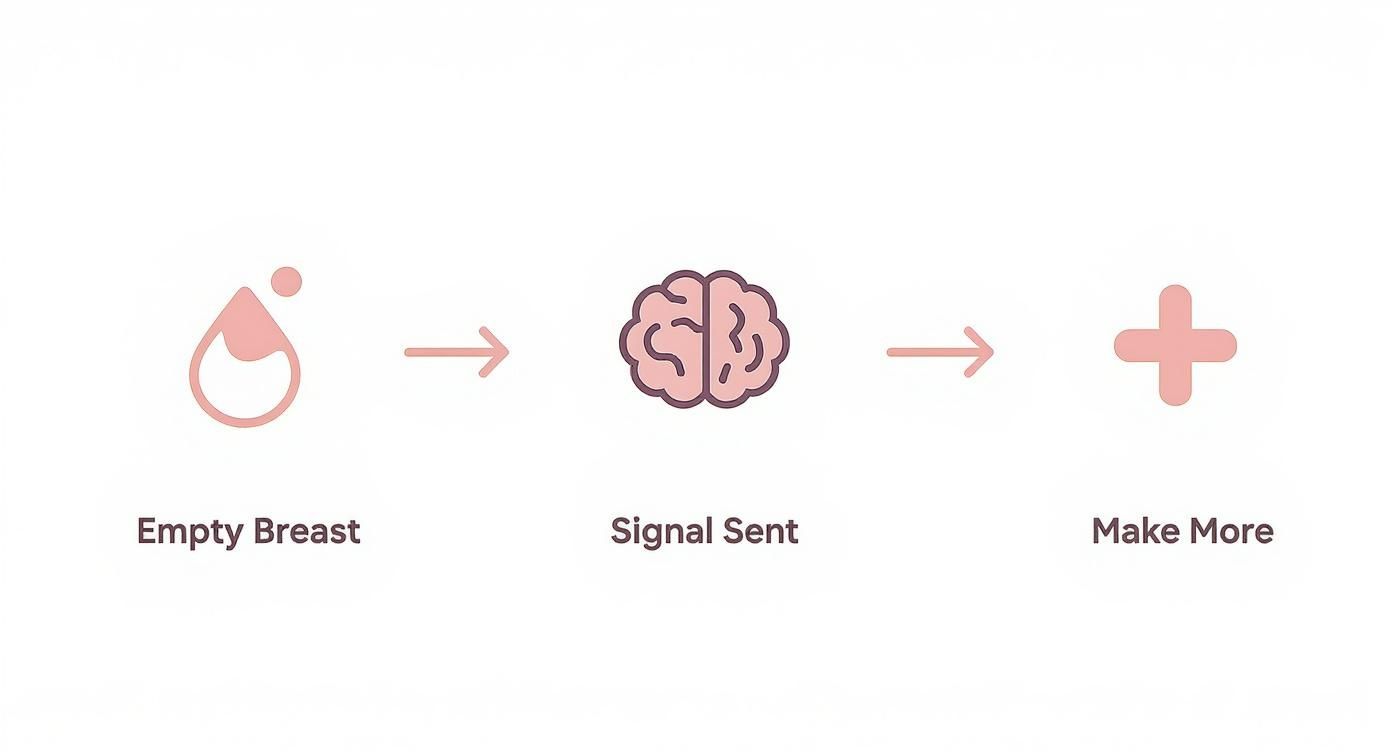
As you can see, it's a cycle: emptying the breast sends a direct signal to your brain, which then tells your body it’s time to restock.
Your goal, every single time, is to empty your breasts as completely and as comfortably as you can. This is the clearest signal you can send to maintain and even increase your milk supply.
Hands-on pumping is incredibly effective, but you want to make sure you're using the right techniques to avoid any issues like clogged ducts. For a great visual guide, check out our post on breast massage techniques for clogged ducts.
Learning to use your pump effectively can make a huge difference in your breastfeeding journey. Recent research found that 91% of breastfeeding mothers use a pump, and on average, they breastfeed for nearly five months longer than those who don't. It just goes to show how a good pumping routine can help you hit your long-term goals. You can read the full study about pump use and breastfeeding duration to see all the details.
Creating a Pumping Schedule That Fits Your Life
For a pumping routine to actually work long-term, it has to be sustainable. Let's forget the rigid, one-size-fits-all rules for a minute. The real goal is to build a flexible schedule that works for you, your baby, and the rest of your life.
Honestly, the best pumping schedule is the one you can stick with without feeling completely burned out.
When you have a solid plan in place, the question of how long to pump breast milk becomes less about watching the clock and more about finding a natural rhythm. Your daily schedule will look totally different depending on whether you're exclusively pumping, just trying to build a freezer stash before heading back to work, or mixing in pumping with nursing.
Sample Pumping Schedules for Different Scenarios
To give you a better idea of what this might look like, here are a couple of real-world examples. Think of these as a starting point, not a strict mandate. Feel free to tweak them based on your baby’s hunger cues and your own energy levels. Remember, consistency is way more important than perfection.
| Time of Day | Exclusive Pumping Schedule | Return-to-Work Pumping Schedule |
|---|---|---|
| 6:00 AM | Pump for 20-30 minutes | Nurse baby before leaving for work |
| 9:00 AM | Pump for 20 minutes | Pump at work for 15-20 minutes |
| 12:00 PM | Pump for 20 minutes | Pump at work for 15-20 minutes |
| 3:00 PM | Pump for 20 minutes | Pump at work for 15-20 minutes |
| 6:00 PM | Pump for 20 minutes | Nurse baby upon returning home |
| 9:00 PM | Pump for 20 minutes | Nurse baby before bed (optional pump after) |
| Overnight | 1-2 sessions as needed | Nurse baby as needed |
These schedules just help you visualize how pumping can fit into different routines, making sure you’re removing milk often enough to keep your supply going strong.
Your Schedule Will Change as Your Baby Grows
Just when you get into a good groove, everything changes—that's parenting! Your pumping needs won't stay the same forever. As your baby gets older, starts eating solid foods, and (fingers crossed) begins sleeping for longer stretches, your schedule can and should evolve.
Around the 6-month mark, many babies start solids, and their milk intake might begin to dip a little. This is often when you can start dropping a pumping session—especially that dreaded middle-of-the-night one—without it tanking your overall supply. For many parents, this is a huge milestone!
The key is to listen to your body and follow your baby's lead. If your breasts feel uncomfortably full, that's your cue to pump. If you notice your supply dipping, you can always add a session back in or try power pumping for a couple of days to boost it.
How to Handle Pumping on the Go
Life doesn’t stop just because you need to pump. Pumping while traveling, at the office, or just running errands takes a bit of planning, but it's totally doable.
- A portable pump is your best friend: A small, battery-operated pump or even a simple manual one can be a lifesaver when you're out and about.
- Pack a dedicated “go bag”: Keep all your essentials—pump parts, a small cooler with an ice pack, cleaning wipes, and extra milk storage bags—in one place so you can grab it and go.
- Know your rights at work: If you're pumping at the office, you have a legal right to a private, clean space (that isn't a bathroom!) and reasonable break time to get it done. Don’t be afraid to advocate for yourself.
Juggling a job and a pumping schedule is a common challenge, but you can absolutely make it work with the right strategy. For a deeper dive, our guide for working moms who are pumping breast milk has fantastic, practical tips to help you navigate this transition.
Building a routine that truly fits your life is the secret to a long and successful pumping journey.
Got Pumping Questions? You're Not Alone.
Even with a solid plan, pumping can bring up a ton of questions. Trust me, we’ve all been there, wondering if we’re getting it right. Let’s walk through some of the most common things new parents ask.
How Do I Know When a Pumping Session Is Actually Done?
This is the big one, right? While you'll hear the 15-20 minute rule thrown around a lot, the real answer has more to do with your body than the clock. Your goal isn't just to pump for a set amount of time, but to fully empty your breasts.
The best way to know you’re done is to watch your milk flow. After your initial letdown, you'll see strong, steady sprays. Once those sprays slow to a trickle or just drips, keep pumping for another 2 to 5 minutes. This little extra time is a game-changer; it helps you get that super-rich, fatty hindmilk and tells your body, "Hey, we need more milk over here!"
What if I Pump for Ages and Get Almost Nothing?
First things first: take a deep breath. A low-output session happens to everyone and it is not a sign that your supply is tanking. It's usually just a sign that something needs a quick adjustment.
Let’s play detective and check a few common culprits:
- Is your flange fit right? This is hands-down the number one reason for low output and discomfort. Your nipple should be able to move freely inside the flange tunnel without pulling in a lot of your areola.
- When was the last time you replaced your pump parts? Those tiny duckbill valves and membranes are workhorses, but they wear out. Plan on replacing them every 1-3 months to keep your pump's suction strong.
- Have you tried warmth and massage? A warm compress before you start can work wonders. Gently massaging your breasts while you pump also helps encourage your letdown and get things flowing.
A quick pro tip: Stress is the ultimate milk-supply killer. If you find yourself staring at the bottles and feeling anxious, cover them up! Look at a photo of your baby, listen to some music, and give your body a chance to relax.
If you're still consistently getting less than you'd like, try adding a daily power pumping session for a few days. And if you’re ever feeling truly stuck, a lactation consultant is an absolute lifesaver for personalized support.
How Long Should I Pump When I’m Away From My Baby?
When you're at work or separated for any reason, the key is to mimic your baby's feeding schedule as best you can. That consistency is what protects your supply.
As a general rule, plan to pump every 3 to 4 hours you're apart. For a typical 8-hour workday, that usually means scheduling two or three pumping breaks. Aim for about 15-20 minutes per session, or until your breasts feel soft and well-drained. Sticking to this schedule will not only maintain your milk supply but also help you avoid the misery of engorgement and clogged ducts.
At Moogco Baby, we know that every feeding journey looks a little different. We're here to support you with thoughtfully curated essentials, from reliable breast pumps to soothing nursing cups, so you can meet your goals with confidence. Explore our collection of feeding and nursing tools.
Bring this guide home with $15 off.
Use code READER15 for $15 off →
Frequently Asked Questions
Can I pump for shorter than 15 minutes if I'm in a rush?
Yes, pumping for 10 minutes is better than skipping a session entirely. While 15-20 minutes is ideal for fully emptying your breasts, a shorter session still removes milk and sends supply signals to your body. Just try not to make short sessions your regular habit, as consistent full emptying is what maintains your supply long term.
Should I pump both breasts at the same time or one at a time?
Studies show it can also help you collect more milk overall because it better mimics the hormonal response of nursing. That said, some moms find single-side pumping more comfortable or effective for triggering letdowns, so do what works best for your body.
Is it normal for one breast to pump longer than the other?
Absolutely, it's completely normal for one breast to have a faster or slower flow than the other. Many moms notice one side is their 'slacker boob' that takes a bit longer to empty. Just keep pumping until both breasts have stopped flowing for a couple of minutes, even if one finishes before the other.
How long should I pump in the middle of the night?
Nighttime pumping sessions typically follow the same 15-20 minute guideline, but your middle-of-the-night supply is often at its peak thanks to higher prolactin levels. You might find you can fully empty in closer to 15 minutes during those late-night sessions. The key is making sure you're fully drained, not rushing through just to get back to sleep.
Does pumping longer than 20 minutes make more milk?
Not necessarily. Once your breasts are fully emptied, continuing to pump doesn't increase the amount you'll get in that session. However, pumping for a few extra minutes after your milk stops flowing (about 2 minutes past the last drops) can be helpful if you're specifically trying to boost your overall supply by sending stronger demand signals.
How do I know if I should pump for 15 or 20 minutes?
Watch your milk flow, not the clock. You're done when the milk has slowed to occasional drops or completely stopped, which usually happens around 15-20 minutes. If your milk stops flowing after just 12 minutes, there's no need to keep going. The goal is empty breasts, and every body empties at a slightly different pace.
Can I pump for too long and damage my nipples?
Yes, over-pumping can absolutely cause nipple soreness, irritation, and even damage your tissue over time. If you're regularly pumping for 30-plus minutes and your breasts have already stopped producing milk, you're likely doing more harm than good. Stick to the 15-20 minute range and make sure your flange fit is correct to avoid unnecessary friction.
Should pumping duration change as my baby gets older?
Your pumping duration will likely stay pretty consistent at 15-20 minutes, but the frequency may change as your baby grows and nurses less often. As you introduce solids around six months and your baby gradually drops feeds, you can adjust your pumping schedule to match. Just remember that removing milk regularly is still key to maintaining whatever supply level you need.
From Moogco Studio
Printable and personalized nursery essentials. Designed by moms for moms.


About the Editor
Eda Ulger is the editor at Moogco Baby and a mom of two. She curates and edits our guides so every piece is honest, practical, and genuinely helpful for the early days of motherhood.














































































































